
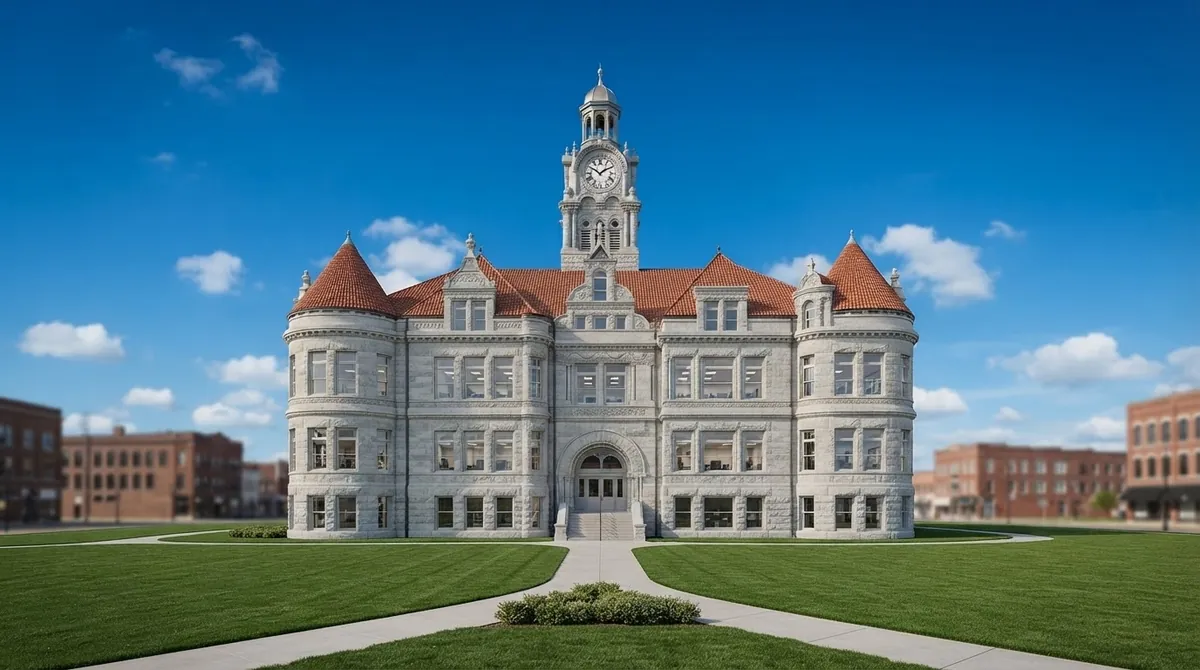
Court records in Dallas County, Iowa are maintained by the clerk of the district court and can be accessed through several channels. DallasIACourt.us can help you find publicly available court record information for Dallas County. You can also use official state court portals, contact the clerk's office directly, or consult other government resources. The Iowa Judicial Branch page for Dallas County and the Iowa Courts public records request page are additional starting points for locating case filings and documents.
Dallas County Court System Overview
Dallas County is part of Iowa's Judicial District 5, which also includes Adair, Adams, Clarke, Decatur, Guthrie, Madison, Marion, Ringgold, Taylor, Union, and Warren counties. The district court in Dallas County is a court of general jurisdiction, meaning it handles all types of cases — criminal, civil, family, probate, and juvenile. The magistrate division operates within the district court and handles smaller civil disputes, simple misdemeanors, and preliminary hearings. Court sessions are held at the Dallas County Courthouse in Adel.
Courts Serving Dallas County
| Court | Address | Phone |
|---|---|---|
| Iowa District Court – Judicial District 5 (Dallas County) | 801 Court Street, Adel, IA 50003 | (515) 993-5816 |
| Magistrate Division – Dallas County | 801 Court Street, Adel, IA 50003 | (515) 993-5816 |
| U.S. District Court – Southern District of Iowa | 123 East Walnut Street, Des Moines, IA 50309 | (515) 284-6248 |
| U.S. Bankruptcy Court – Southern District of Iowa | 110 East Court Avenue, Suite 300, Des Moines, IA 50309 | (515) 284-6230 |
Dallas County does not have a separate municipal court. Traffic and ordinance violations within incorporated cities are generally handled through the district court's magistrate division.
What Types of Cases Dallas County Courts Hear
Courts in Dallas County handle a wide range of matters. The following case types are heard at either the district court or magistrate level:
- Felonies and indictable misdemeanors
- Simple misdemeanors and infractions
- Civil litigation (all dollar amounts)
- Small claims
- Traffic violations and OWI/DUI cases
- Family law — divorce, custody, child support, paternity, protection orders
- Probate — estates, guardianships, conservatorships
- Juvenile delinquency and child protective proceedings
- Adoption and termination of parental rights
District Court Cases in Dallas County
The district court in Dallas County hears felony criminal cases after a preliminary hearing or grand jury indictment, as well as indictable misdemeanor cases. Civil lawsuits exceeding the magistrate court's jurisdictional limit are filed here. The district court also handles appeals from magistrate court decisions and post-conviction relief proceedings. District judges and district associate judges preside over these cases. Cases are assigned based on the court's internal scheduling procedures, and filings are processed through the clerk of court office. Documents can be submitted electronically through the Iowa Judicial Branch eFile system.
Magistrate Court Cases in Dallas County
The magistrate division in Dallas County handles simple misdemeanors, scheduled violations, and infractions. Magistrates also conduct preliminary hearings in felony cases and initial appearances. On the civil side, magistrate judges hear cases involving claims up to $6,500 under Iowa law. Small claims cases — with a jurisdictional limit of $6,500 — are also heard in magistrate court. Traffic violations, including OWI arraignments, are typically handled at this level. Magistrate judges may also issue search warrants and emergency protective orders. If you need to contest a traffic ticket or file a small claims action, the magistrate division at the Dallas County Courthouse is where to start.
Family Law, Probate, and Juvenile Matters in Dallas County
Family Law
Divorce, custody, child support, paternity, civil protection orders, and termination of parental rights cases are handled by district judges and district associate judges in Dallas County. These cases are filed with the clerk of court and follow Iowa's family law statutes under Iowa Code Chapters 598, 600B, and 236.
Probate
Probate matters — including decedent estates, guardianships, conservatorships, and trust proceedings — are heard by the district court. Filings go through the clerk's office. Iowa Code Chapter 633 and Chapter 633A govern these proceedings.
Juvenile
Juvenile cases, including delinquency proceedings under the Iowa Juvenile Justice Reform Act and child-in-need-of-assistance (CINA) cases under the Iowa Child Protective Act, are heard in the district court. Juvenile court records are confidential under Iowa law. The Fifth Judicial District's Department of Correctional Services provides juvenile court services for Dallas County.
How Cases Move Through the Dallas County Court System
- Filing / Initiation: A case begins with the filing of a criminal complaint, civil petition, or other initiating document with the Dallas County Clerk of Court. Electronic filing is available through Iowa's eFile system.
- Assignment to Judge: The case is assigned to a district judge, district associate judge, or magistrate depending on the case type and jurisdictional requirements.
- Initial Hearing: Criminal defendants have an initial appearance or arraignment. Civil cases receive a scheduling order or conference.
- Pre-Trial Phase: Parties engage in discovery, file motions, and — in criminal cases — may negotiate plea agreements. Mediation may be ordered in family or civil disputes.
- Trial or Resolution: Cases proceed to trial (jury or bench), or are resolved through plea, settlement, dismissal, or default judgment.
- Post-Judgment: Criminal cases move to sentencing. Civil judgments may be appealed or enforced. Appeals from the district court go to the Iowa Court of Appeals.
Court Administration, Local Rules, and Public Access in Dallas County
The courts in Dallas County are administered under the authority of the Chief Judge of the Fifth Judicial District. A trial court administrator oversees day-to-day operations across the district. Local court rules for Judicial District 5 supplement the statewide Iowa Court Rules, which include Chapter 20 on court records and Chapter 16 on electronic procedures.
Under Iowa law, most court records are generally open to the public. Exceptions include juvenile records, sealed records, confidential mental health and substance abuse records, and certain records in adoption and domestic abuse cases. The Iowa Judicial Branch outlines the process for public records requests — district court case records are available by contacting the clerk of court in the county where the case was filed.
Hearings in Dallas County are typically held in person at the courthouse. Some proceedings may be conducted by telephone or video at the court's discretion. Contact the clerk's office to confirm hearing format for a specific case.
Court Records and Related Court Resources in Dallas County
- Court Case Search: The Iowa Judicial Branch offers an online case search tool through Iowa Courts Online (ICIS), accessible from the Dallas County district court page. You can look up case numbers, parties, and basic docket information.
- Electronic Filing: Attorneys and self-represented parties can file documents, track case status, and receive filings through the Iowa eFile system.
- Public Records Requests: For copies of court documents not available online, submit a request to the Dallas County Clerk of Court. The Iowa Judicial Branch public records page explains the process and any applicable fees.
- Criminal History Background Checks: The Iowa Division of Criminal Investigation processes criminal history record checks. You can also request a background check through Iowa.gov.
- Inmate Search – Dallas County Jail: The Dallas County Inmate Inquiry tool shows individuals currently in custody at the Dallas County Jail.
- Iowa Offender Search: The Iowa Department of Corrections offender search provides information on individuals under DOC supervision, including current location and status.
- Iowa Department of Corrections: The Iowa DOC website offers resources for inmates and families, including visitation information and open records requests.
- Vital Records: Birth, death, and marriage certificates are available through the Iowa Department of Health and Human Services – Vital Records. Historical vital records may also be found through the State Historical Society of Iowa.
- Property and Tax Records: The GeoDallas GIS portal provides assessment and tax information for properties in Dallas County.
- Court Rules: The full text of Iowa Court Rules — including rules on court records, electronic procedures, and judicial administration — is available through the Iowa Legislature's court rules page.
- Self-Help Resources: The Iowa Judicial Branch website provides court forms, self-representation guides, and information on how to pay fines or file a case. Visit DallasIACourt.us for additional guidance on locating Dallas County court record information.